Notre-Dame de l’agenouillade or Notre-Dame de la genouillade is a must-see spot in Grau d’Agde, not only because of its rich history, but also because of the friendly atmosphere that reigns on this square in fine weather.
As soon as you arrive in Le Grau d’Agde, you won’t want to miss the chapel, its small adjoining pine forest, and its large square with the rock at the top of which the Virgin is kneeling. On the other side of the square is the larger Notre-Dame du Grau church, currently being restored by the town of Agde. The terrace of the bar-restaurant installed on the square brings it to life during the summer months. A warm atmosphere in the heart of a place steeped in history. Try it out for an authentic experience during your vacation in Agde.
The origins of the Notre-Dame de l’agenouillade legend
The history of the Agenouillade site begins around 450 AD, with the arrival of Saint-Sever, most likely from Syria. Legend has it that Saint-Sever left his homeland after an earthquake, abandoning almost all his wealth: half was given to the needy, the other half was thrown into the sea. He then let his boat decide his fate, sailing at will. He ended up stranded on the Agatha coast, on the site of today’s Agenouillade, where he decided to settle. With his last savings, he built a small Hermitage where he lived a simple, religious life until his death.
During a particularly violent storm, the monks surrounding Saint-Sever witnessed a sudden and unprecedented rise in water levels, leading to fears that the town would be engulfed. One of the monks, praying for the town’s salvation, saw the Virgin Mary kneeling and praying beside him, facing the sea. Immediately the sea calmed and the waters receded.
From this apparition and miracle, the footprint of the Virgin’s knee in the ground remained. A chapel was built around it to protect and venerate it. In the center of the chapel, the knee print can still be seen today, albeit protected by a series of railings. The Chapelle Notre-Dame de l’agenouillade, a true emblem of Grau d’Agde, is built entirely of Basalt (volcanic stone from the Agde volcanic complex). The side reinforcements you can see on the sides of the chapel are not original, but were added during a renovation supervised by the famous Eugène Viollet-le-duc.
The Chapelle Notre-Dame de l’agenouillade is open to visitors from 10 a.m. to 6 p.m. every day.
Protection of sailors and ex-votos
Thanks to its waterfront location, the chapel and later the church of Notre-Dame-du-Grau became a place of prayer for sailors and their families. Some praying for a favorable fate on their forthcoming voyage, others giving thanks for having returned alive from their last voyage, or families praying for the return of their loved ones or bodies lost at sea. Over the decades, the chapel and church were filled with numerous ex-voto (votive religious offerings).
Unfortunately, the works that were not looted at La Révolution were stolen in the 1970s. What’s more, the various frescoes on the walls have been covered in grey concrete. The chapel is therefore rather austere. Only the ceramics in the heart of the chapel add a touch of color, while briefly retracing the key stages in the legend of Notre-Dame de l’agenouillade.
On the roof of the chapel, you can see the Lantern of the Dead, once illuminated to guide the bodies and souls of sailors who died at sea and whose bodies had not been found, and later used by pilgrims to reach Notre-Dame de l’agenouillade by night.
Pilgrimage and golden age of Notre-Dame de l’agenouillade
After Saint-Sever’s death, the Benedictines took over the care of the site. In 1667, Duke Henri 1er de Montmorency, Governor of Languedoc, commissioned the Capuchins to build a larger, more lavishly decorated church opposite the chapel: Notre-Dame-du-Grau, as well as a monastery.
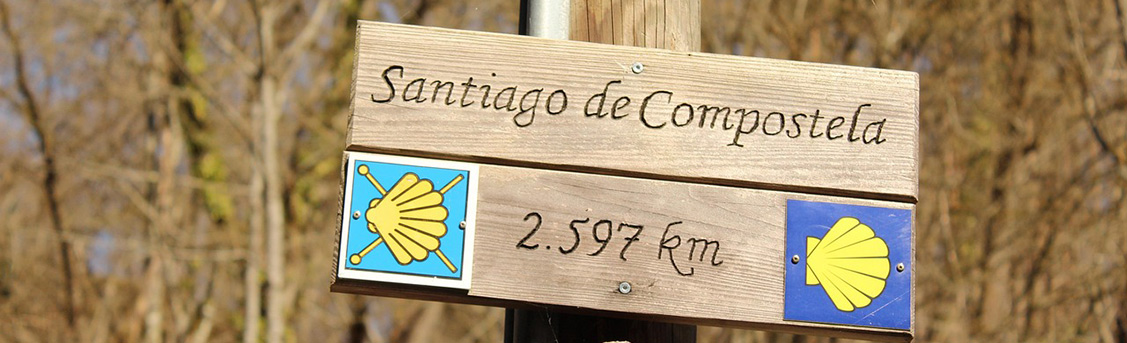
Until the 19th century, Notre-Dame de l’agenouillade was a golden age for the pilgrimage route to Santiago de Compostela. A major place of pilgrimage, the religious site received an average of 50,000 people a day, according to the writings of the time, and even 100,000 on peak days. Religious tradition has it that the water in the cavity formed by the Virgin’s knee could cure fevers and eye diseases.
In the middle of the square, between the chapel and the church, you can see the Virgin kneeling on a rock. This artificial rock was built in 1920 to pay homage to the history of the place, but also to allow the expression of popular piety. A little hidden secret: the rock houses its own system of gears to draw water from the natural underground spring on site. In the past, this was used to supply the fountain on the rock. Today, due to the region’s severe drought, all the town’s fountains are shut down. The ivy that once covered the rock and damaged it has been removed and replaced by climbing roses.
The dark hours of Notre-Dame de l’agenouillade
Since the year 450, the site of Notre-Dame de l’agenouillade has also experienced darker times, often leading to the loss of this priceless historical and religious heritage.
The Revolution, and 1793 to be precise, was a dramatic period for the Genouillage site. The church and monastery were ransacked and pillaged before being sold off as public property. During this period, the church was even transformed into a salting plant for pigs.
During the Second World War, the entire area around Grau d’Agde and La Tamarissière was occupied by the Germans and completely militarized. At La Tamarissière, around 30 of the 100 bunkers built in the Agde commune have survived. The agenouillade area was no exception: military camps were set up there. The square concrete structure next to the chapel is the remains of the camp’s water supply, which also served as a swimming pool for German soldiers.
A glimmer of hope in the midst of these dark hours, it was at this time that the stained glass window above the chapel door was installed. Unfortunately, no information is available to identify the family who made this offering, or the artist who created the stained glass, whose colors are particularly beautiful and successful. Given the situation at the time, the installation must have been concealed.
More recently, in the 1970s, the many ex-voto paintings hung in the chapel and church over the years and centuries were stolen, leaving both religious buildings empty.
Did you know?
In love with the place, Henri 1er de Montmorency was buried in the church, according to his wishes, under the central aisle as close to the heart as possible, so that as many people as possible could walk over him.
During the looting of the French Revolution, Montmorency’s bones were dug up and thrown into a mass grave. Shocked by this scene, an Agatha resident recovered the bones and hid them again under the church where they had been. They were only rediscovered when the church was recently renovated. The bones have now been identified as those of Montmorency. An unknown woman is also buried here. So is one of the monks of the monastery.
Have you noticed?
Have you noticed the cast-iron marker on the lower right of the façade of the Chapelle de l’Agenouillade?
Mostly laid in the 19th century, these levelling marks, on which the word “urbanisme” is inscribed, give the altitude at a precise point. This enabled the French relief to be mapped. Recent checks have confirmed that the measurements taken at the time were extremely accurate.
Keep an eye out for them on other religious buildings, bridges and old constructions all over France…
Notre-Dame du Grau and Notre-Dame de l’agenouillade today
It wasn’t until 1873, thanks to a public subscription, that Notre-Dame du Grau once again became the property of the town of Agde.
Today, the Mairie d’Agde regularly organizes free guided tours of the Notre-Dame de l’agenouille site. An enthusiastic guide will retrace the history of the agenouillade from the earliest legends to the present day. During this privileged tour, you’ll also have the opportunity to visit the church of Notre-Dame du Grau, whose restoration is well underway. A beautiful church to discover if you get the chance. The team at your La Tamarissière campsite particularly appreciated :
- The sublime stained glass windows, in dazzling colors, whose existence is unimaginable from the outside.
- The various decorations in the side chapels have been meticulously restored: in particular, the statute of the Virgin Mary has been renovated with gold leaf and a remarkable blue starry sky. Great care was taken to find pigments as close as possible to the original ones, to guarantee the authenticity of this renovation…



