Better known for its beaches and seaside resorts of Cap d’Agde, Grau d’Agde and La Tamarissière than for its rich heritage and culture, the town of Agde nevertheless has some wonderful discoveries in store for the more curious…
The latest archaeological finds prove that the history of the town of Agde, nicknamed the Black Pearl of the Mediterranean, dates back to 800 BC. And that’s just the beginning!
Its history is closely linked to the Hérault River that flows through the town, its direct access to the Mediterranean Sea, the region’s volcanic past and the power of its archbishopric until the French Revolution. All these factors have helped shape the town of Agde as we know it today. Keep your eyes peeled for all this as you stroll through Agde.
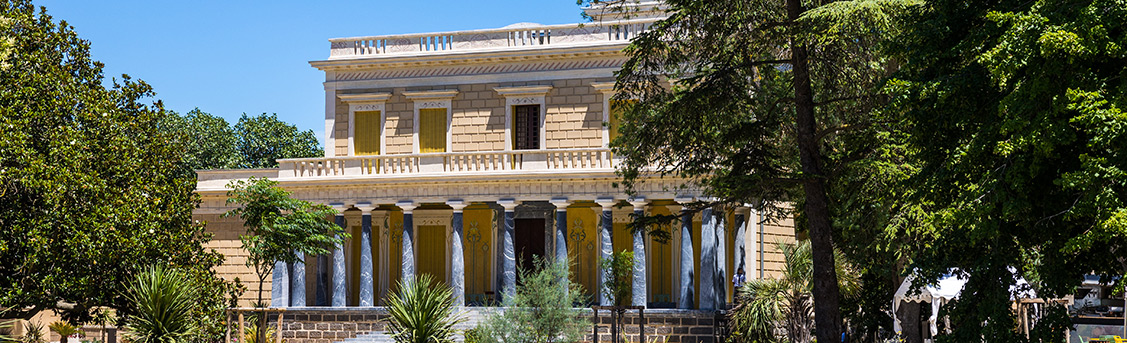
Along the water’s edge, you’ll discover the architectural and historical nuggets that form the identity of the town of Agde: the Villa Laurens, the Moulin des Évêques, Saint-Etienne’s Cathedral, the quays lined with old fishermen’s and shopkeepers’ houses…
L’Hérault is also the cultural heart of the town, where jousting tournaments and concerts by renowned artists take place on the floating stage set up for the occasion during the summer season.
Let’s discover Agde and its riches along the water…
Château Laurens, a must-see jewel in the Agatha region
Villa Laurens: the work of Emmanuel Laurens
Emmanuel Laurens was born in Agde in 1873 into a noble, middle-class family of master masons. At the age of 23, he left to study medicine in Montpellier. His meeting with his distant maternal cousin, Baron de Fontenay, was to change his destiny. This whimsical, party-going man took a liking to Emmanuel Laurens. To everyone’s surprise, when he died a few months later, he bequeathed his entire considerable fortune to Emmanuel Laurens.
Passionate about art, history and literature… Emmanuel Laurens, at the head of this fortune, put an end to his medical studies and set off on his travels: Egypt, Africa, Madagascar… As fate would have it, a few months later, his father also died. Emmanuel Laurens had to return home. At just 24, he inherited companies and land on Belle-Isle in Agde: 12 hectares bordered by the Canal du Midi, the Hérault and crossed by the railway line, an exceptional asset at the time.
In 1897, Emmanuel Laurens undertook a major project at Belle-Isle, exploiting the strengths of the land’s location. He took advantage of the proximity of the Hérault river to set up an ingenious system for creating electricity, supplying his estate and installing central heating at Villa Laurens. A technological feat of exceptional comfort for the time. With the railway line running through the estate, Emmanuel Laurens had a station stop created right in front of his home, with direct access. Once again, a strong point for the time, offering great mobility and the possibility of easily entertaining guests for colorful evenings.
Let’s talk about the building itself. Emmanuel Laurens designed the Château Laurens himself, so that the residence would be entirely in his image. An anti-conformist, like himself, the Villa Laurens is an architectural and artistic jewel blending different styles and influences with panache. The Château Laurens’ heteroclytic, colorful architecture and decor are clearly inspired by the art-nouveau style that Emmanuel Laurens loved so much. The influences of his travels, particularly in Egypt, the Middle East and Africa, are also very much in evidence.
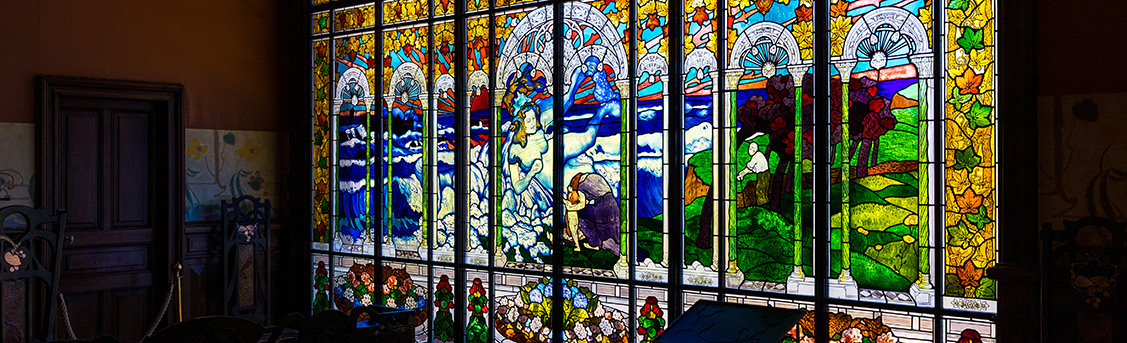
When you visit Villa Laurens, observe everything, for everything has been thought out and worked on down to the smallest detail: the cobra-shaped door hinges, the sculpted window handles, the decorated cast-iron radiators, the hidden meanings of the paintings, the details of the decorative objects, the story told by the stained-glass windows, the bright colors of the decorative earthenware on the outside, or the shadows drawn in the earthenware in the bathroom… Even the stables are luxurious at Villa Laurens and well worth a visit.
Emmanuel Laurens, with great taste, fine-tuned everything, chose top-quality materials from all over Europe and surrounded himself with artists to create unique pieces tailor-made for Château Laurens. Eugène Dufour, for example, painted the grand salon. Eugène Simas is the genius behind the sublime stained glass windows in the study and music room, as well as the fabulous bathroom with its pool-like bathtub made entirely of Sarreguemines earthenware. We owe the furniture to the renowned cabinetmaker Léon Cauvy.
In 1921, following his meeting with singer Louise Blot, whom he married the same year, Emmanuel Laurens had a music room built at Château Laurens. It is perhaps the masterpiece of the Villa Laurens. It impresses with its immense ceiling height, exaggerated stained-glass windows and cathedral-like gilded ceiling.
The decline of Villa Laurens
After years of glitz and glamour, bad investments and disastrous management, Emmanuel Laurens was no longer able to maintain the estate and Château Lauren. The estate was sold as a life annuity in 1938, but the Villa Laurens was no longer maintained at its fair value.
During the Second World War, the German army established a command post within the Château, resulting in the loss of many valuable objects and extensive damage. When Emmanuel Laurens died in 1959, the new owners used the estate as a vineyard, growing cotton and cultivating the huge orchard of apple, pear and peach trees. Château Laurens was then completely abandoned.
Aware of the dormant artistic, cultural and tourist potential of this exceptional residence, the town of Agde bought Château Laurens and its gardens in 1994. It was classified as a Historic Monument in 1996. The largest restoration project in Occitania began in 2017.
The rebirth of Château Laurens
The forgotten jewel of the town of Agde, Château Laurens is once again ready to shine for all to see, after a long renovation phase initiated 6 years ago. It could welcome over 100,000 visitors a year.
This titanic project represents an investment of 15 million euros and 6 years of work. The Agglo Hérault-Méditerranée invested 12 million euros. Substantial funding was also provided by Europe, the French State, the Region and the Département.
To begin with, major work was carried out on the building’s structure to ensure the longevity of this unique and emblematic historic monument, which is unfortunately subject to a number of threats: vibrations caused by passing trains on the nearby railway line, humidity and flooding from the Hérault river, and ground movement caused by the region’s drought…
The building, meanwhile, has been restored to its flamboyant paintings and stained-glass windows, its unique ironwork, earthenware and woodwork… as well as some of its original furniture. Everything has been faithfully restored.
The garden has also received special attention. This new green lung of Agde will be freely accessible all year round.
The area closest to the château stands out with its majestic 100-year-old magnolia tree. 6,000 ground cover plants and 1,000 bulbs have been replanted in this area to restore the splendor of the Villa Laurens entrance.
The second part of the garden, with its water basin, was planted with 1,450 plants, 35 trees, 210 palms and cacti to create a lush atmosphere.
Finally, further away from the château, the orchard has been restored with the planting of 540 fruit trees: Brazilian guava, pecan walnut, quince, fig, mulberry, olive, pistachio…
Visit Château Laurens Agde
After 6 years of renovation, Château Laurens has been restored to its former glory and will be open to visitors from June 23, 2023. A new must-see in the Hérault region for history, culture and art enthusiasts.
Opening hours
June to September
Tuesday to Sunday – 11 a.m. to 7 p.m.
October to May
Tuesday to Sunday – 10 a.m. to 6 p.m.
Closed from December 1 to March 1
Your Agde sightseeing tour
To complete your visit to Agde, on the banks of the Hérault, observe and admire :
The Moulin des évêques, which has had several lives and functions over the centuries, is one of the vestiges of the power of the Archbishopric of Agde until the French Revolution. Built in the mid-13th century on the model of an impregnable fortress, 9 millstones ran at full capacity until the 17th century, handling over a ton of wheat a day. An enormous source of income for the clergy. Sold at auction during the French Revolution, the bishops’ mill was successively used as a flour mill, hydro-electric power station and sardine cannery. The building was renovated and refurbished in 2007 thanks to private and public funding. It now houses accommodation and an exhibition hall.
The Cathédrale Saint-Etienne, built entirely of basalt, the volcanic stone from Agde and Cap d’Agde, gives it a unique allure. The organ you can see here was a gift from Emmanuel Laurens. It was purchased for his wife’s music room at Château Laurens. Too large for the room, it was later donated to the city for the Cathedral. Made entirely of wood, it has been painted to imitate marble. A real beauty!
The 10 kilometers of basalt quays, built in the 18th century and lined with the old houses of fishermen and merchants.
The Round Lock of the Canal du Midi, the work of Pierre-Paul Riquet, linking the Atlantic to the Mediterranean.
Camping La Tamarissière in Agde
Just 5 kilometers from the center of Agde, Camping La Tamarissière is the ideal place to put down your bags for your vacation in the Hérault region. With its direct access to a long, beautiful sandy beach, you can enjoy the pleasures of the beach on the Agde coast. Just a few kilometers from Cap d’Agde, one of France’s biggest seaside resorts, you’ll be able to take advantage of its many activities while staying in the calm and cool of a protected natural pine forest.
In this privileged setting, Camping La Tamarissière offers pitches for caravans, motorhomes and tents, pitches with private sanitary facilities, comfortable chalets, family cottages with large terraces and bungalows with private swimming pools.



