In Languedoc-Roussillon in general, and in the Hérault in particular, many towns have a totem animal that serves as an emblem and protector of the community.
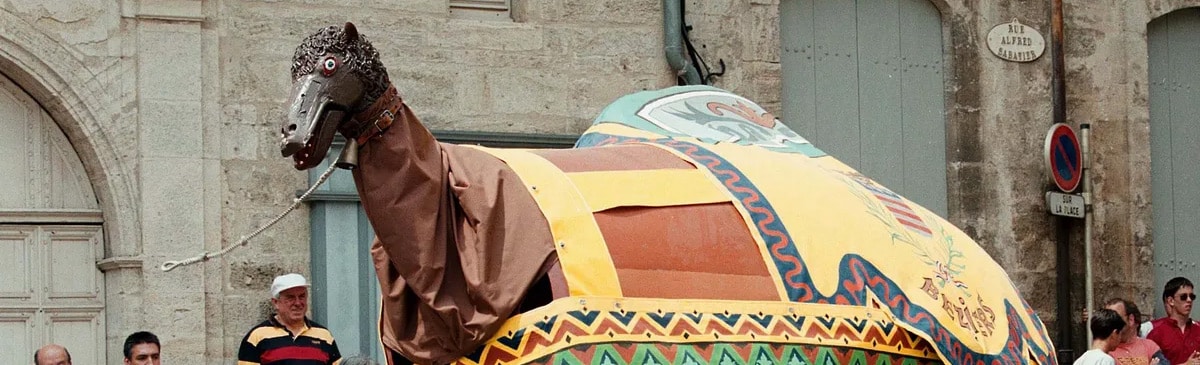
The best-known are the Pézenas foal, less than thirty minutes from our campsite near Pézenas, which appears on Shrove Tuesday and during the summer festivals, the Béziers camel, which takes part in the St. Aphrodise festival at the end of April and in the parade during the August feria.
There’s also the Montagnac goat, the Loupian wolf, the Bessan donkey, the Pinet caterpillar, and the Servian stag…
We can’t list them all, because there are so many. There are so many traditions to discover from our 4-star campsite in the Hérault.
History of Hérault totemic animals
These totemic animals originate from an oral tradition dating back to the 16th century, but their origins go back much further, to the Middle Ages.
In these tales, these animals have an oracular or ominous value. The Pinet caterpillar, for example, devours vine leaves, symbolizing the scourge of winegrowers.
Most, however, would be quite benevolent.
Gignac’s donkey became the town’s emblem after it saved the inhabitants from a night-time attack by Saracen raiders.
As for the Montagnac goat, its milk cured serious illnesses.
During traditional celebrations, these animals take on colorful, free and whimsical forms for fun with family and friends. Made of wood and covered with colorful canvas, they wander through the villages, carried by the locals who sit inside. The animal moves to the beat of the music and the mood of the carriers. Most of the time, it’s best to pull over when they pass!
The Pézénas foal, traditional folklore
The Pézénas foal, traditional folklore
In 2005, it was awarded the title of “UNESCO Masterpiece of the Oral and Intangible Heritage“.
Its history dates back to Louis VIII.
On his way to the Crusades, the King stopped off in the commune. His mare being ill, he entrusted her to two consuls, Antoine PONS and Simon BARRAL, asking them to take care of her.
On his return, the monarch was surprised to see his mare, which he had thought dead, standing next to a magnificent foal whose head was adorned with ribbons and foliage for the occasion.
Surprised and charmed, Louis VIII wanted to perpetuate this event in memory. He had a wooden foal built, which the town admitted to all public festivals from 1226 onwards, as a token of friendship for the King.
Much later, according to legend, the Maréchal de BASSONPIERRE, who was passing through Pézénas, wanted to cross LA PEYNE on horseback.
On the same bank, he would have spotted a peasant woman rolling up her skirts to cross the river as well.
The Marechal took her by the rump to lead her across, and the two of them entered the town under the amused gaze of the inhabitants. To commemorate this event, ESTIENOU and ESTIENEITTE were perched on the old colt in 1622 and have remained there ever since.
In the old days, when the foal went out to public festivities, the animal would beg for money for the poor. Even today, the Pézénas colt is followed by players of the fife, oboe and tambourine. There’s a whole ritual between the red-and-white-clad leader and the animal.
The ringleader comes up to the foal, sifts it with oats, jumps up, turns on himself, steps back and rushes over to the animal. This unchanging ritual takes place every year.
The same is true of the music that is heard and passed down from generation to generation.
To better manage and maintain this custom, the association “LES AMIS DU POULAIN” was created in 1981. Its members ensure that this cultural heritage is preserved and does not fall into oblivion.
In 2019, as part of Heritage Day, the famous confrérie du petit pâté de Pézénas will enthrone the foal during an extraordinary chapter where it will be presented to the public wearing its new, completely redesigned and reworked dress.
If you are lucky enough to be near Pézénas for one of the foal’s outings, don’t hesitate to come to this highly festive event, which is sure to delight you.
Local festivals where totemic animals can be seen
- PÉZÉNAS: Carnival in February
- BÉZIERS: April 28 for Saint-Aphrodise, then in August for the Féria
- PINET: July at the local festival
- BESSAN: August donkey festival
- MONTAGNAC: September for the fête votive
- LOUPIAN: September for the local festival
You can easily find all the dates by searching on google.



